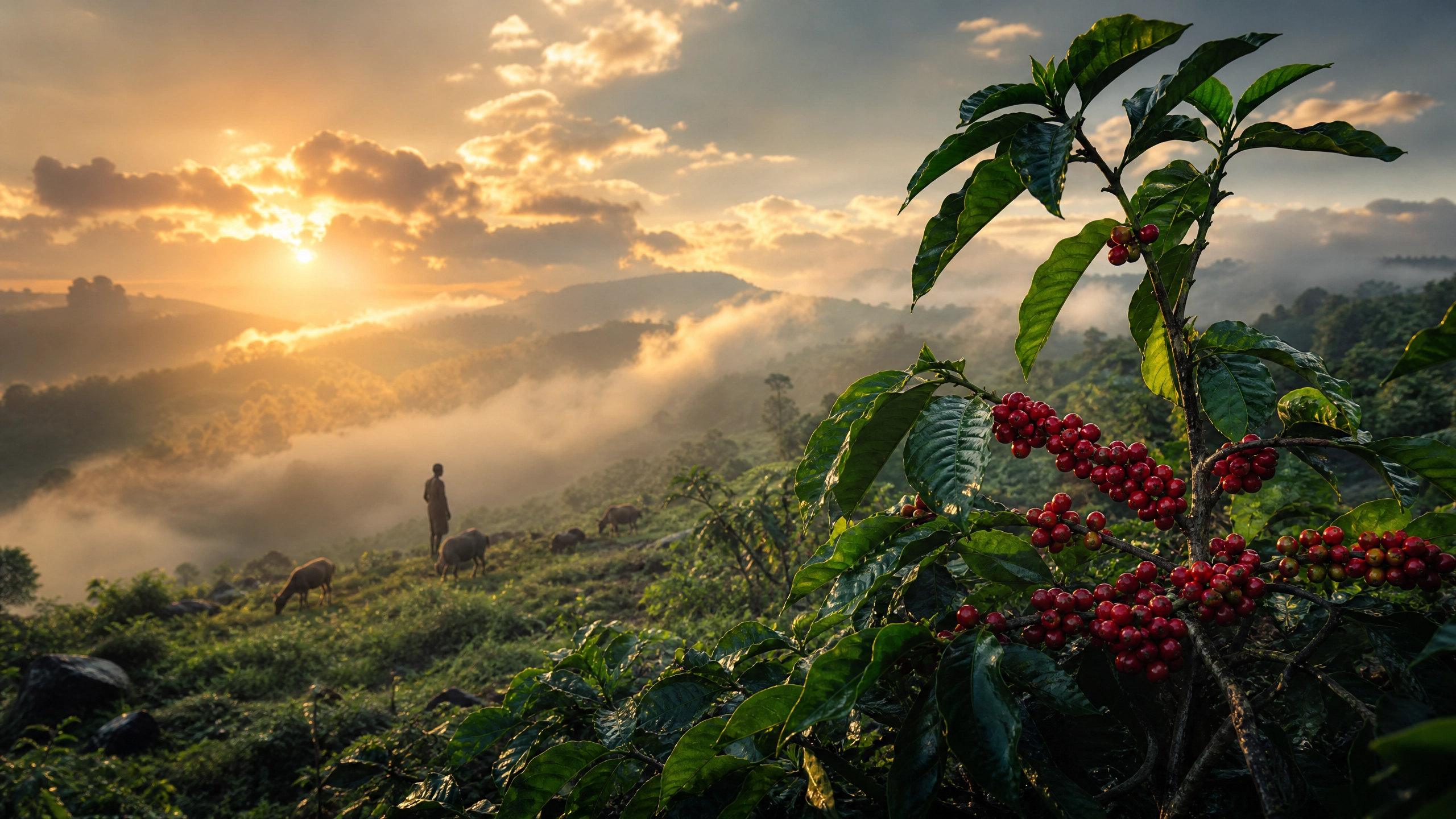
🎯 Learning Goal
By the end of this lesson, you will know where Arabica coffee came from and why it matters to Bhutanese coffee farmers.
The Story of Kaldi
One bold bite in the Ethiopian hills changed how the world wakes up forever.
A famous legend says that around 600 AD, a goat herder named Kaldi noticed something unusual—his goats became energetic after eating bright red coffee cherries.
Curious, Kaldi tasted the cherries himself and also felt more alert and awake.
He shared the cherries with nearby monks, who began drying them so they could be stored and transported. Over time, coffee spread from Ethiopia to many parts of the world.
Key Facts
Did You Know?
Early coffee was eaten as a fruit before people discovered how to prepare it as a drink.
Quick Check
❌ Incorrect. Try again!
✔️ Correct! Ethiopia is widely known as the birthplace of Arabica coffee.
2.Why did the monks value coffee cherries?
❌ Oops, wrong answer!
✔️ Correct! Monks consumed coffee cherries to help maintain focus and alertness.
Farmer's Takeaway
The roots and history of Arabica coffee cultivated globally and in Bhutan today trace back to Ethiopia. Because Arabica thrives in cool mountain environments, Bhutan has outstanding potential to produce premium specialty coffee.
Remember
Every cup of Arabica coffee traces its roots back to the mountain forests of Ethiopia.
By the end of this lesson, you will understand how Arabica coffee traveled from Ethiopia to become a crop grown around the world.
From Ethiopia to Yemen
One coffee plant. Many journeys. A global tradition.
After the discovery of coffee in Ethiopia, Arabica began its journey to other parts of the world.
At first, people used the outer skin of coffee cherries to prepare a tea-like drink.
The Birth of Modern Coffee
During the 15th and 16th centuries, roasting and brewing coffee over open flames became popular across the Middle East and the Ottoman Empire. This process brought out coffee's rich flavor and launched modern coffee culture.
Coffee Travels Across Continents
Coffee continued its journey:
1600s — Europe
From a simple drink to a powerful tradition, coffee houses became places where great ideas were born.
1700s — Asia
1700s — Americas
A single coffee plant brought to the Caribbean island of Martinique helped establish millions of coffee trees within a few decades.
Coffee Today
Today, coffee has become one of the world's most loved agricultural products.
1.Which country first cultivated Arabica coffee outside Ethiopia?
✔️ Correct! Yemen was the first place where Arabica coffee was grown commercially outside Ethiopia.
2.What process created the familiar coffee flavor we know today?
✔️ Excellent! Roasting releases the aroma and flavors inside the coffee bean.
Arabica coffee has traveled across mountains, oceans, and continents for hundreds of years. Today, Bhutan is part of this global coffee story. The mountain landscapes and cool climate provide conditions that can support the production of high-quality Arabica coffee.
Coffee began as a wild plant in Ethiopia, traveled through Yemen and the world, and eventually reached mountain farms like those in Bhutan.
By the end of this lesson, you will know the main types of coffee grown around the world and understand why Arabica is important for Bhutan.
Three Main Coffee Types
Arabica dominates the global market, making up to 70% of world coffee production.
There are three main coffee species grown around the world:
1. Arabica (Coffea arabica)
Known for: High-quality specialty coffee
2. Robusta (Coffea canephora)
Known for: Strength and productivity
3. Liberica (Coffea liberica / Coffea excelsa)
Known for: Large trees but limited production
A Special Arabica Variety: Catimor
Among Arabica varieties, Catimor is a commonly known type.
Every carefully selected bean is a sip of liquid gold
However:
Catimor may produce lower cup quality compared with some traditional Arabica varieties because of differences in acidity and body.
A smaller coffee tree is often preferred by farmers because:
This is especially important for farmers working on Bhutan's steep mountain slopes.
✔️Correct! Arabica is highly valued for its aroma, flavor, and quality.
âś” Great job! Smaller trees reduce harvesting difficulty and labor costs.
For Bhutanese farmers, choosing the right coffee variety is important.
For Bhutan's specialty coffee future, understanding and managing the right Arabica varieties is key.
By the end of this lesson, you will understand the ideal environment Arabica coffee needs to grow healthy and produce quality beans.
Arabica Likes the Right Home
Arabica coffee is a mountain crop. Its growth and coffee quality depend on:
Choosing the right location before planting is one of the most important decisions a farmer can make.
1. Soil: Coffee Needs Healthy Roots
Arabica coffee grows best in soil that is:
Coffee roots need oxygen. Avoid areas where water stays after rain.
Poor choices:
Ideal Soil Condition
Slightly acidic soil is best.
Ideal pH range: 5.5–6.5
đź’ˇ Farmer Tip: Adding compost, leaf mulch, and organic matter can improve soil health.
2. Altitude: Higher Mountains, Better Quality
Arabica performs well at higher elevations.
Recommended altitude:
1,200–2,500 meters above sea level
Higher elevations often produce better coffee quality because:
For Bhutan, many mountain areas naturally provide suitable conditions for Arabica.
3. Temperature: Coffee Prefers Cool Weather
Arabica coffee prefers: 15°C–24°C
Too much heat can: Stress the plant, Reduce growth, Affect coffee quality
Very cold temperatures and frost can also damage coffee.
Solution: Planting suitable shade trees can help protect coffee plants from extreme temperatures.
4. Rainfall and Water: Balance Is Important
Arabica needs:
Around 1,200–1,800 mm rainfall per year
But rainfall must be well distributed.
Too little water:
Too much water:
Young Coffee Plants Need Extra Care
After planting:
Farmer Tip: Mulching with leaves and farm materials helps coffee survive dry periods.
5. Wind Protection
Strong winds can damage coffee by:
Protect coffee farms with:
The same mountain conditions that make Bhutan beautiful—cool temperatures, high elevations, and forest environments—can also help produce high-quality Arabica coffee.
❌ Incorrect — Give it another shot!
✔️ Correct! Coffee roots need oxygen and good drainage.
2.Why can higher altitude improve coffee quality?
✔️Excellent! Cooler conditions allow beans to develop better aroma and taste.
Before planting coffee, always ask:
âś… Is the soil deep and well-drained?
âś… Is the altitude suitable?
âś… Is there enough water?
âś… Can the farm be protected from strong winds?
Good location selection is the first step toward producing quality Bhutanese Arabica coffee.
Choose the right environment, and the coffee plant will reward you.