

Spryng is profiling Bhutan’s boldest innovators to explore how the carbon-negative nation is "debugging" the future of regenerative business and stakeholder capitalism.

Most entrepreneurs solve for "clicks." Thinley Namgay decided to solve for soil, mountain logistics, and the fragility of an edible flower.
In the global tech economy, a degree in Information Technology is a golden ticket to a climate-controlled office and a predictable salary. Thinley Namgay had the ticket. He just chose not to use it.
Instead of debugging code, Thinley decided to debug a far more complex system: the fractured agricultural supply chain of rural Bhutan.
Most "back to the land" stories are rooted in nostalgia. Thinley’s was rooted in a laptop and a realization. While working as the production head at Happy Chips, he saw the anatomy of a business collapse. When the company folded, he didn't update his CV for a desk job. He opened his laptop in a series of borrowed café corners and began designing Bhutan Blossoms.

From paper to purpose—determination leads in the life of Thinley Namgay.
The "Fragility" Problem
In 2018, the dream was simple but statistically improbable: export organic herbs, teas, and highly delicate edible flowers from the landlocked Himalayas to the high-end markets of Switzerland and the USA.
To do this, Thinley had to solve three "bugs" that no software could fix:
-
The Labor Leak: Youth migration was emptying villages of their best workers.
-
The Wildlife Tax: Human-wildlife conflict regularly wiped out entire harvests.
-
The Trust Deficit: Traditional farmers were skeptical of a "tech guy" talking about profit-sharing.
Innovation via Profit-Sharing
Thinley didn’t just hire farmers; he engineered a new social architecture. By partnering with the Drachukha Flower Group—a collective of four women entrepreneurs—he moved away from the extractive model of "buying low and selling high."
Instead, he implemented a profit-sharing system that turned laborers into stakeholders. This wasn’t just "doing good"; it was smart business. When the farmers own the upside, they find more creative ways to protect the crops from wild boars and mountain storms than any hired guard ever would.
"It’s not about the money in the bank," Thinley says, "it’s about the agility of the community. When the logistics of the Himalayas try to break your supply chain, only a community that feels ownership will help you fix it."
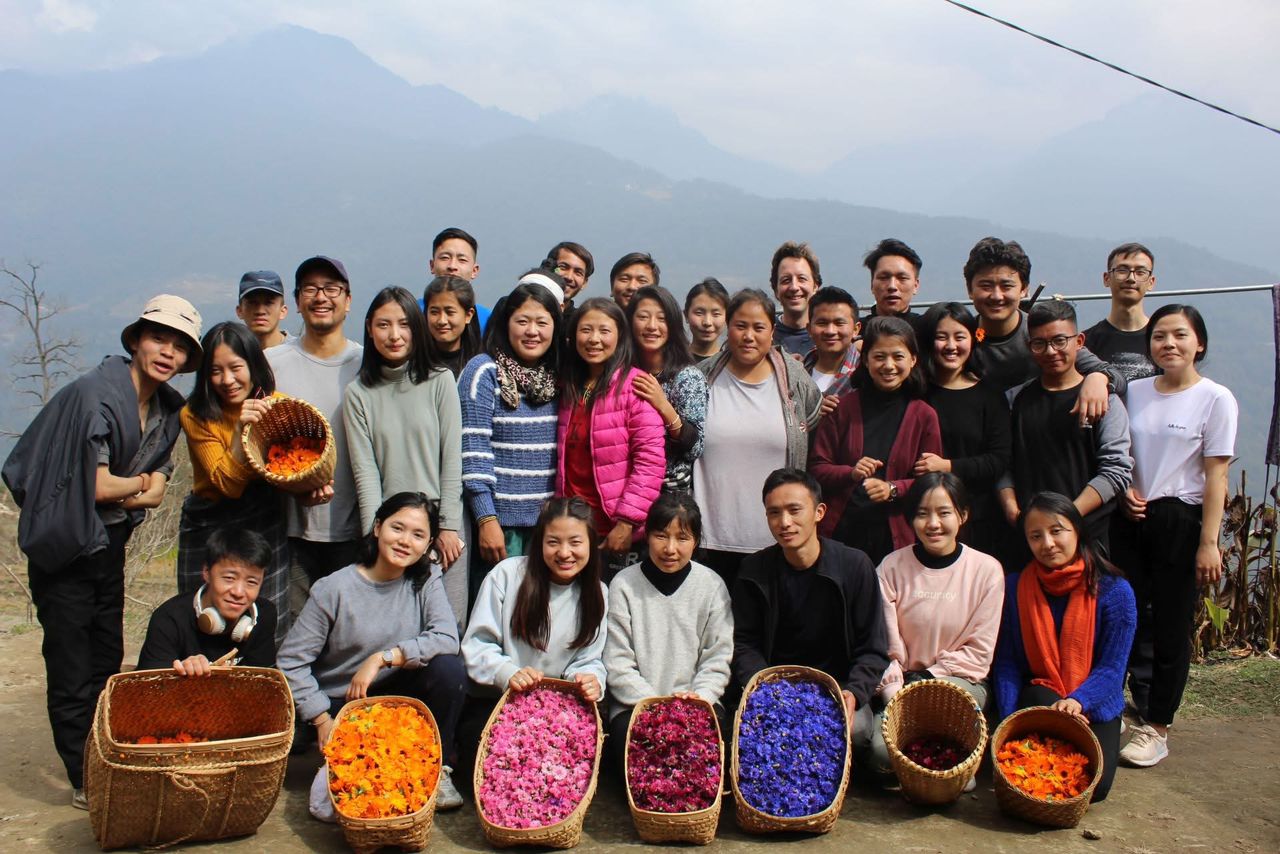
Great change often begins with a single small effort. Some of the farmers Thinley works with.
From Cafés to Global Shelves
Today, Bhutan Blossoms is a case study in Resilient Scaling:
-
The Reach: From a single laptop, the company now manages a network of 150 farmers.
-
The Footprint: Products are currently landing in Australia, the US, and Europe—defying the "landlocked" disadvantage through high-value, low-weight exports.
-
The Future: Thinley is already moving into nutraceuticals, applying his IT-honed precision to the science of organic supplements.
Thinley had to rebuild trust in villages, shift traditional mindsets, and navigate labour shortages caused by youth migration. He faced gaps in scientific farming knowledge, constant human-wildlife conflict, and the everyday unpredictability of agricultural life. Each challenge demanded a smarter solution—and he kept finding them.
Today, Bhutan Blossoms are stronger, smarter, and unmistakably resilient. Its products now reach the USA, Switzerland, and Australia, defying the logistical challenges of exporting from the Himalayas. The company has grown to 11 employees and 2 interns, and its vision continues to expand: larger organic farming communities, new product lines, and future nutraceutical innovations.
Looking back, Thinley carries one thing more than pride—gratitude.
He has worked with nearly 150 farmers, listened to their stories, and helped unlock new possibilities in their lives. He knows none of this could exist without the community that believed in him.
https://bhutanblossoms.com/
The Spryng Insight
We are taught that "stability" comes from following the script—the degree, the desk, the steady climb. Thinley Namgay proves that true stability is found in intentional disruption. By taking the logic of a systems architect and applying it to the soil, he didn’t just build a company; he built a repeatable model for rural revival.
The Actionable Takeaway: The next time you face a "system failure" in your career, don't look for a better script. Look for the "unwanted" opportunity—the edible flower in the middle of a labor shortage—and build the community required to move it.