
Artificial intelligence. The words conjure images of sentient robots, self-driving cars, and algorithms that predict our every move. It sounds complex, intimidating, and maybe even a little scary. But what is AI, really? And why is everyone talking about it?
Fear not, dear reader. This isn't another jargon-filled tech article designed to make you feel inadequate. We're here to demystify AI, break it down into bite-sized pieces, and show you that it's not some futuristic boogeyman, but a powerful tool that's already shaping our world in profound ways. Think of this as your AI for Dummies guide, Spring edition.
A Brief History: From Dreams to Reality
The seeds of AI were sown long before computers even existed. Philosophers and mathematicians have, for centuries, pondered the possibility of creating machines that can think. But the official birth of AI as a field is generally marked by the 1956 Dartmouth Workshop, where researchers gathered to explore the potential of "thinking machines."
The early years were filled with optimism. Researchers predicted that machines would be able to solve complex problems and even exhibit human-level intelligence within a few decades. However, progress proved to be slower and more difficult than anticipated. Funding dried up, and AI entered a period known as the "AI winter."
But the dream never died. Thanks to advancements in computer hardware, data availability, and new algorithms, AI experienced a resurgence in the late 20th and early 21st centuries. Today, AI is used in a wide range of applications, from medical diagnosis to fraud detection to personalized recommendations on Netflix.

From Turing's vision to today's reality, the journey of AI has been a long and fascinating one.
What Is Artificial Intelligence, Anyway?
At its core, AI is about creating machines that can perform tasks that typically require human intelligence. These tasks include:
- Learning: Acquiring knowledge and skills from data.
- Reasoning: Drawing inferences and making decisions based on available information.
- Problem-solving: Finding solutions to complex problems.
- Perception: Interpreting sensory input, such as images, sounds, and text.
- Natural Language Processing: Understanding and generating human language.
In simpler terms, AI is about making computers "smart." But it's important to understand that AI isn't about creating machines that are conscious or have feelings. It's about creating machines that can perform specific tasks intelligently.
The Different Flavors of AI: A Quick Guide
AI comes in many forms, each with its own strengths and weaknesses. Here are a few of the most common types:
- Machine Learning (ML): This is the most popular type of AI. ML algorithms learn from data without being explicitly programmed. They identify patterns, make predictions, and improve their performance over time. Think of it as teaching a computer to recognize cats in pictures by showing it thousands of cat pictures.
- Deep Learning (DL): A subset of machine learning, deep learning uses artificial neural networks with multiple layers to analyze data. This allows DL algorithms to learn more complex patterns than traditional ML algorithms. DL is behind many of the recent breakthroughs in AI, such as image recognition and natural language processing.
- Natural Language Processing (NLP): NLP focuses on enabling computers to understand and generate human language. NLP is used in applications such as chatbots, machine translation, and sentiment analysis.
- Computer Vision: This field focuses on enabling computers to "see" and interpret images. Computer vision is used in applications such as facial recognition, object detection, and medical image analysis.
- Robotics: Robotics combines AI with engineering to create intelligent robots that can perform tasks in the physical world.
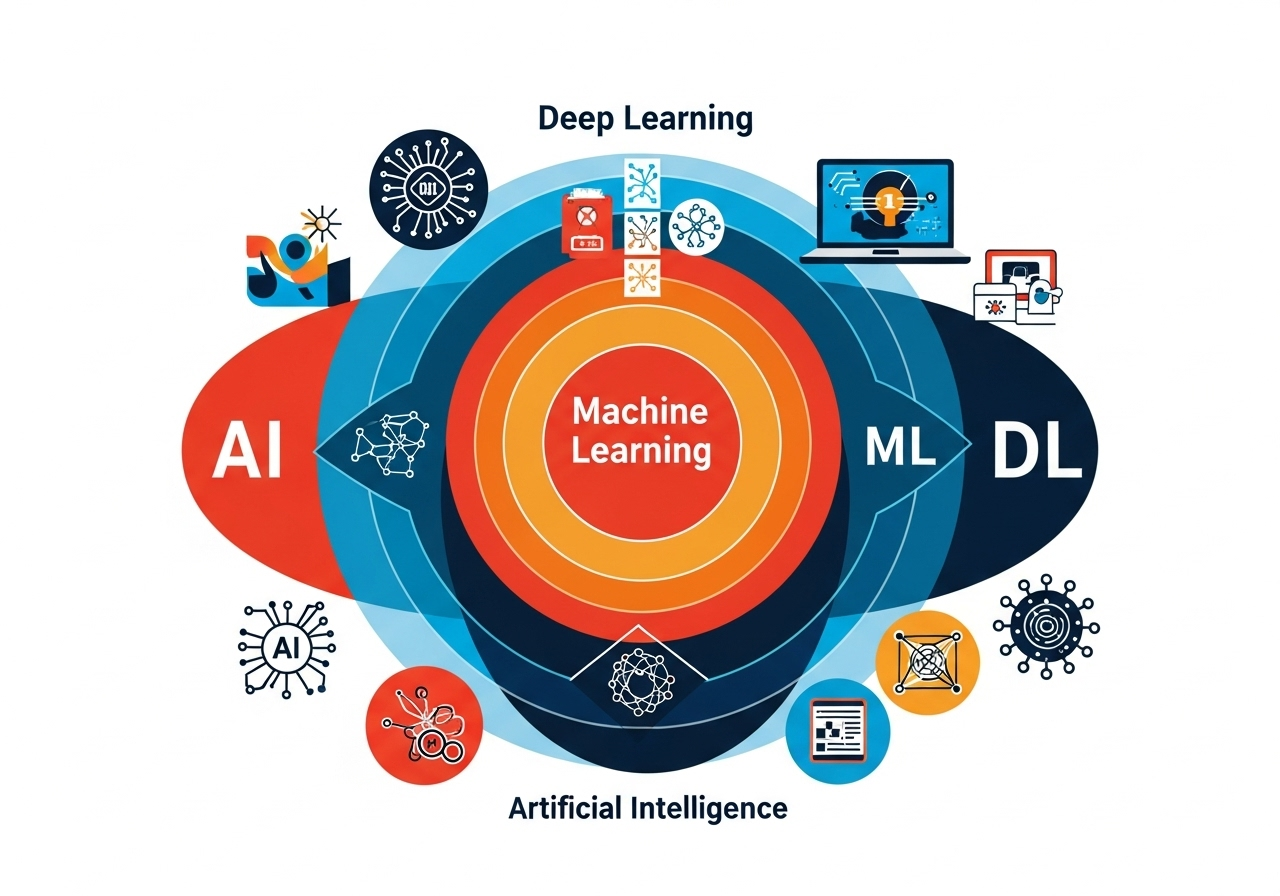
AI encompasses a wide range of techniques, with Machine Learning and Deep Learning being key components.
AI in the Real World: It's All Around You
AI is no longer a futuristic fantasy. It's already woven into the fabric of our daily lives. Here are just a few examples:
- Recommendation systems: Netflix, Amazon, and Spotify use AI to recommend movies, products, and songs that you might like.
- Spam filters: AI algorithms filter out spam emails and protect you from phishing scams.
- Virtual assistants: Siri, Alexa, and Google Assistant use AI to respond to your voice commands and answer your questions.
- Self-driving cars: AI is the brains behind self-driving cars, enabling them to navigate roads and avoid obstacles.
- Medical diagnosis: AI is being used to diagnose diseases, analyze medical images, and personalize treatment plans.
- Fraud detection: Banks and credit card companies use AI to detect fraudulent transactions.
The Future of AI: Promise and Peril
AI has the potential to revolutionize many aspects of our lives, from healthcare to transportation to education. It could help us solve some of the world's most pressing problems, such as climate change and poverty.
However, AI also raises some important ethical and societal concerns. These include:
- Job displacement: As AI becomes more capable, it could automate many jobs currently performed by humans.
- Bias and fairness: AI algorithms can inherit biases from the data they are trained on, leading to unfair or discriminatory outcomes.
- Privacy: AI systems often collect and analyze vast amounts of data, raising concerns about privacy and security.
- Autonomous weapons: The development of autonomous weapons systems raises the specter of machines making life-or-death decisions without human intervention.
It's crucial that we address these concerns proactively to ensure that AI is used for the benefit of all humanity. This requires careful planning, thoughtful regulation, and ongoing dialogue between researchers, policymakers, and the public.

AI offers incredible potential, but we must be mindful of the ethical considerations.
Getting Started with AI: It's Easier Than You Think
You don't need to be a computer scientist to understand and use AI. There are many resources available to help you get started:
- Online courses: Platforms like Coursera, edX, and Udacity offer courses on AI and machine learning
- Books and articles: There are many excellent books and articles that explain AI in plain English.
- Open-source tools: Libraries like TensorFlow and PyTorch make it easy to experiment with AI algorithms.
- AI communities: Join online communities and forums to connect with other AI enthusiasts and learn from their experiences.
The most important thing is to be curious and open-minded. AI is a rapidly evolving field, and there's always something new to learn. So, dive in, explore, and discover the power of artificial intelligence for yourself.
References